
Famous Sports Photographers – 10 Iconic Sport Photographers & Their Camera Gear
Sports photography is more than just capturing athletes in motion — it’s about freezing moments of passion, intensity, and triumph that define the spirit of competition. From breathtaking action shots to emotional behind-the-scenes glimpses, the best sport photographers have an uncanny ability to tell powerful stories through their lenses.
In this blog, we highlight famous sport photographers who have shaped the art of action photography and explore what they captured, why their work matters, and what camera gear these leading sport photographers use to get unforgettable photos.
Sport photographers capture the emotion, action, and defining moments of competition — from grassroots matches to global events. Whether working for media, brands, or clients, they combine technical skill with perfect timing to tell powerful visual stories.
What Do Sport Photographers Do?
Sports photographers specialise in capturing fast-paced moments as they unfold, whether that’s at a local match or a major international event. Much of their work involves covering live sport, where there’s no second chance to get the shot. They need to anticipate key moments—goals, finishes, reactions—and position themselves to capture them in real time.
A big part of the role is freezing action and emotion together. It’s not just about sharp images of athletes in motion, but also the intensity, pressure, and atmosphere that define sport. The best sports photographers tell a story through their images, from the build-up to the decisive moment and the reactions that follow.
Sports photographers may work across different areas of the industry. Some focus on editorial work, shooting for newspapers, magazines, or online publications where images are used to document events and tell news stories. Others work in commercial photography, creating content for brands, teams, sponsors, or advertising campaigns. While the environments differ, both require strong technical skills, quick decision-making, and an ability to consistently deliver high-quality images under pressure.

Neil Leifer
Famous Sport Photographer: Neil Leifer
Neil Leifer is a name synonymous with the golden era of sports photography. Over a career spanning more than six decades, Leifer has captured some of the most iconic and emotionally powerful moments in sports history. His work often cited as appearing on over 200 Sports Illustrated covers. Reportedly a record in itself and has also graced the pages of Time, Life, and Newsweek.
Famous Work: Ali vs. Liston (1965) – Leifer’s most famous and widely recognized image is of Muhammad Ali standing over Sonny Liston after knocking him down in the first round of their 1965 rematch. Taken from a perfectly positioned angle, the photo captures Ali’s raw power, charisma, and defiance, frozen in a moment of pure athletic drama. This photo is often considered one of the greatest sports photographs ever taken. It represents not just a victory in the ring, but the cultural and political rise of Ali himself.

© Neil Leifer - "Ali vs. Liston (1965)"
Early Life and Education
Neil Leifer was born on December 28, 1942, in New York City. Growing up, Leifer was captivated by both sports and photography, a passion that would shape the trajectory of his entire life.
Leifer’s journey into photography began in a rather humble and unconventional way. As a teenager, he joined a photography class at the Henry Street Settlement House, a local community centre. That class gave him access to basic camera equipment and a darkroom—tools that would become the foundation of his career.
By 16, Leifer had already made a splash: his photo of Alan Ameche scoring the game-winning touchdown in the 1958 NFL Championship Game (known as “The Greatest Game Ever Played”) was published in Sports Illustrated. This early success helped launch his professional career before he ever attended college.
He briefly attended New York University, but his real education came from the streets, stadiums, and darkrooms of New York and the mentorship he received from editors and fellow photographers at Sports Illustrated.
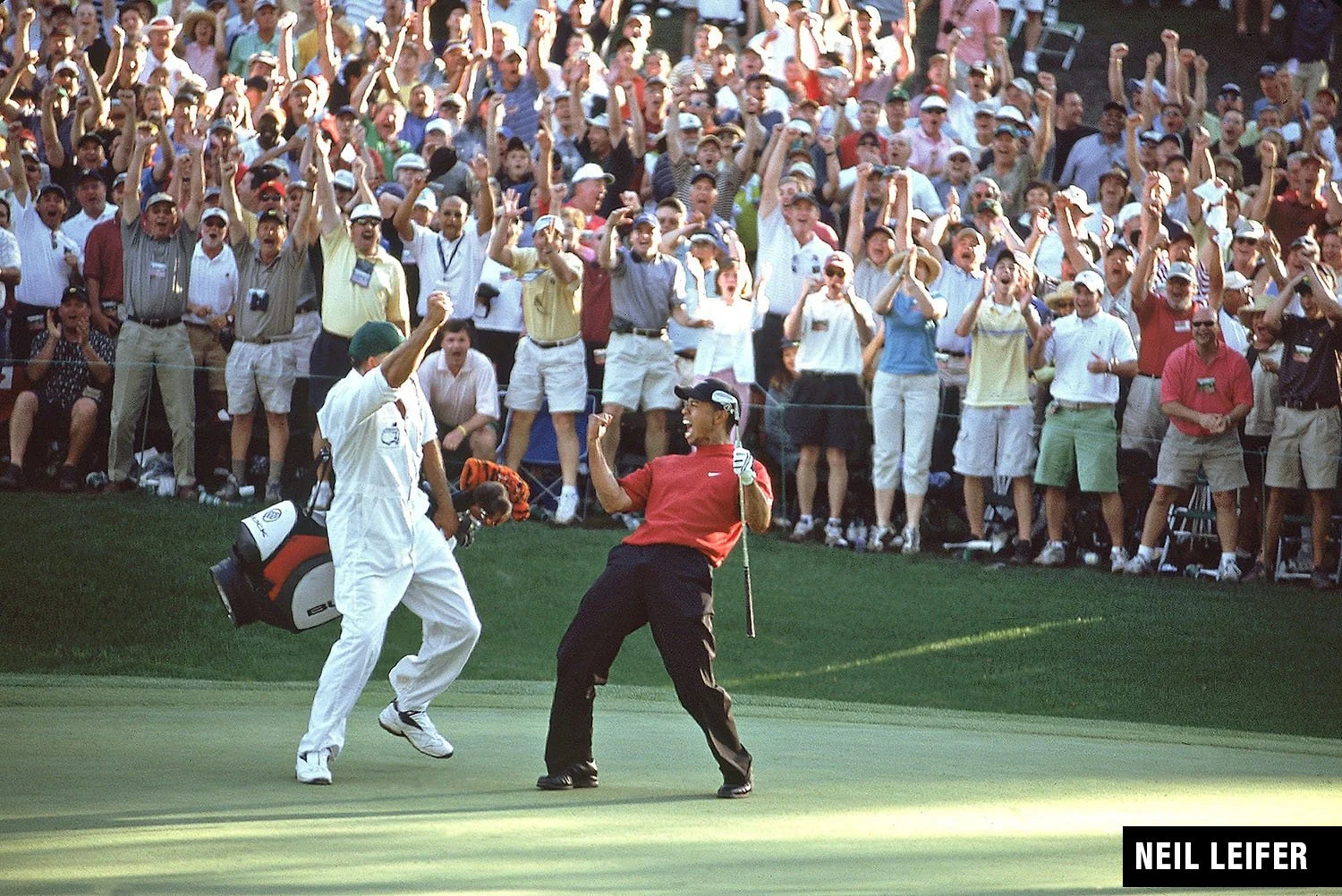
Neil Leifer, Tiger Woods at the 2005 Masters
Impact on Photography
Leifer's sports photography is known for its vibrant colour, flawless composition, and an ability to anticipate decisive moments. He had an intuitive sense of timing and positioning—never just capturing the action, but the emotion and the story behind it.
His work has elevated sports photography to fine art, influencing generations of photographers and shaping how we visually experience sports and his photographs have been exhibited in galleries and museums worldwide, including the Smithsonian and the International Center of Photography.
Gear: What Camera Does Neil Leifer Use?
Over the years, Leifer has worked with top-tier Nikon and Canon camera systems, combining wide-angle and telephoto lenses to achieve powerful and varied compositions. To keep pace with the speed of elite sport, he made use of high-speed motor drives for rapid continuous shooting, while carefully placed strobes and flash helped him freeze motion and highlight the intensity of pivotal moments.
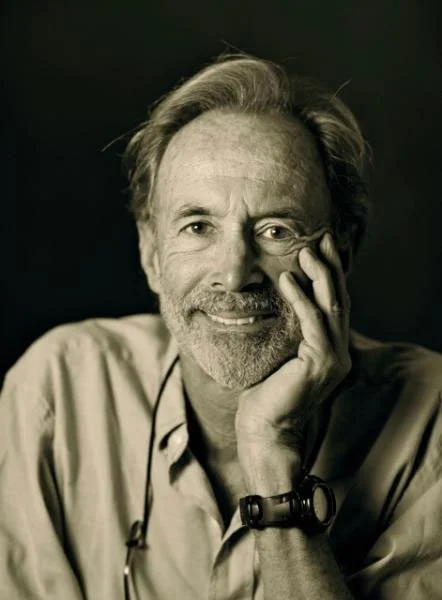
Walter Looss Jr.
Famous Sport Photographer: Walter Iooss Jr.
Walter Iooss Jr. is widely regarded as one of the greatest sports photographers of all time. Known for his unmatched ability to capture the grace, intensity, and humanity of athletes, Iooss has spent over six decades behind the lens documenting some of the most iconic figures and moments in sports.
Famous Work: “The Catch” – Dwight Clark, 1982 NFC Championship (Game played Jan 10, 1982 – 1981 season) – Walter Iooss Jr.'s image of "The Catch" is one of his most famous works, and one of the most important photographs in the history of American sports. During the NFC Championship Game between the San Francisco 49ers and the Dallas Cowboys, wide receiver Dwight Clark made a leaping, fingertip touchdown catch in the back of the end zone from a pass by Joe Montana with less than a minute left in the game. Iooss Jr. was on the sideline, perfectly positioned with his lens trained on the moment. He captured Clark’s full-body extension, arms outstretched, mid-air, catching the ball at its highest point, with defenders just below and a packed stadium in the background.
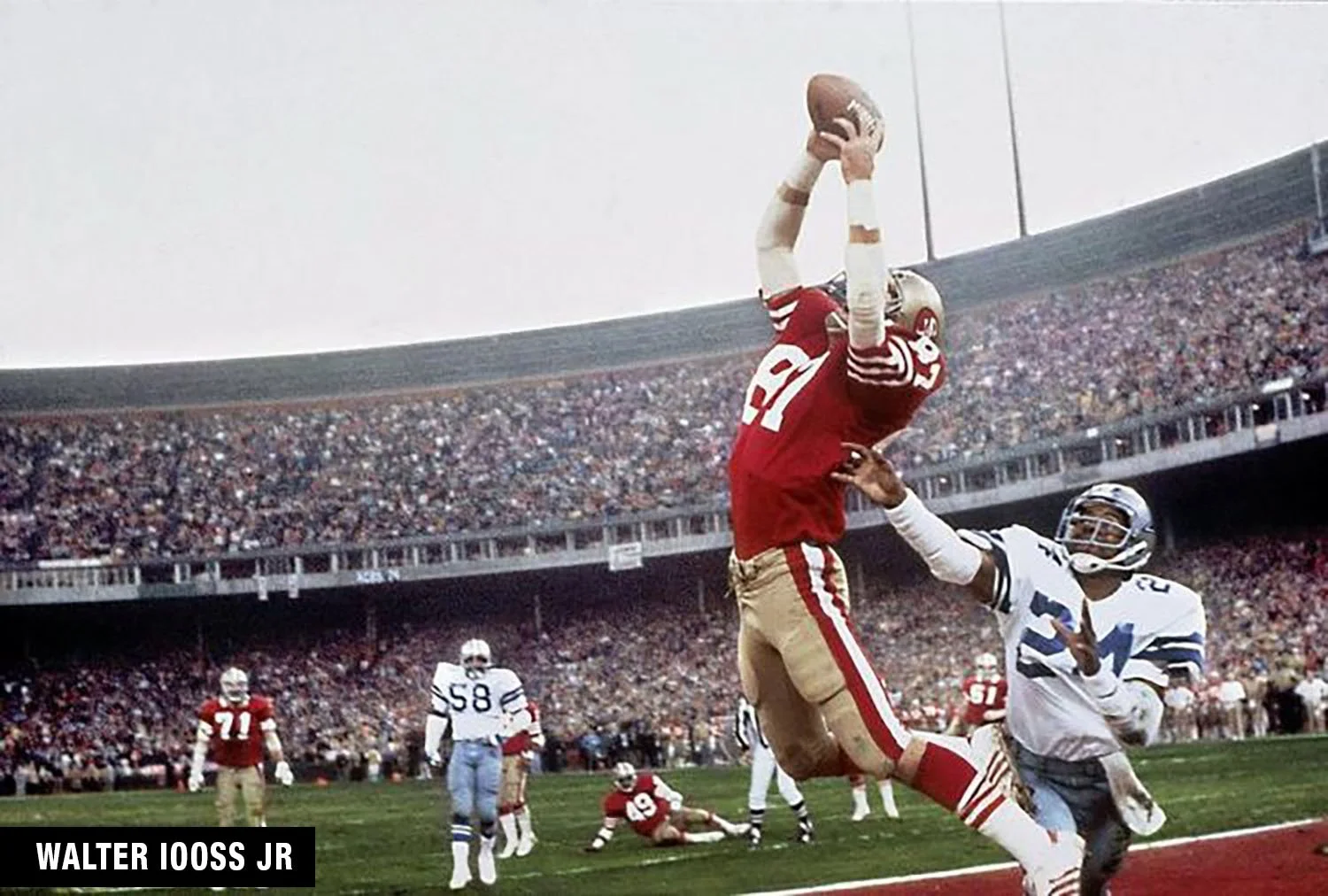
© Walter Iooss Jr. - “The Catch”
Early Life and Education
Born on September 15, 1943, in Temple, Texas, and raised in New York, Walter Iooss was interested in photography from a young age. By age 17, his talent was already undeniable—he landed his first professional assignment with Sports Illustrated while still in high school.
Iooss briefly studied at the German-based School of Modern Photography, but like many great artists, his real education came through hands-on experience. He quickly became known for his creativity, eye for composition, and an ability to connect with his subjects.
By age 20, he had shot his first Sports Illustrated cover, and by his mid-20s, he was considered one of the top photographers in the world.
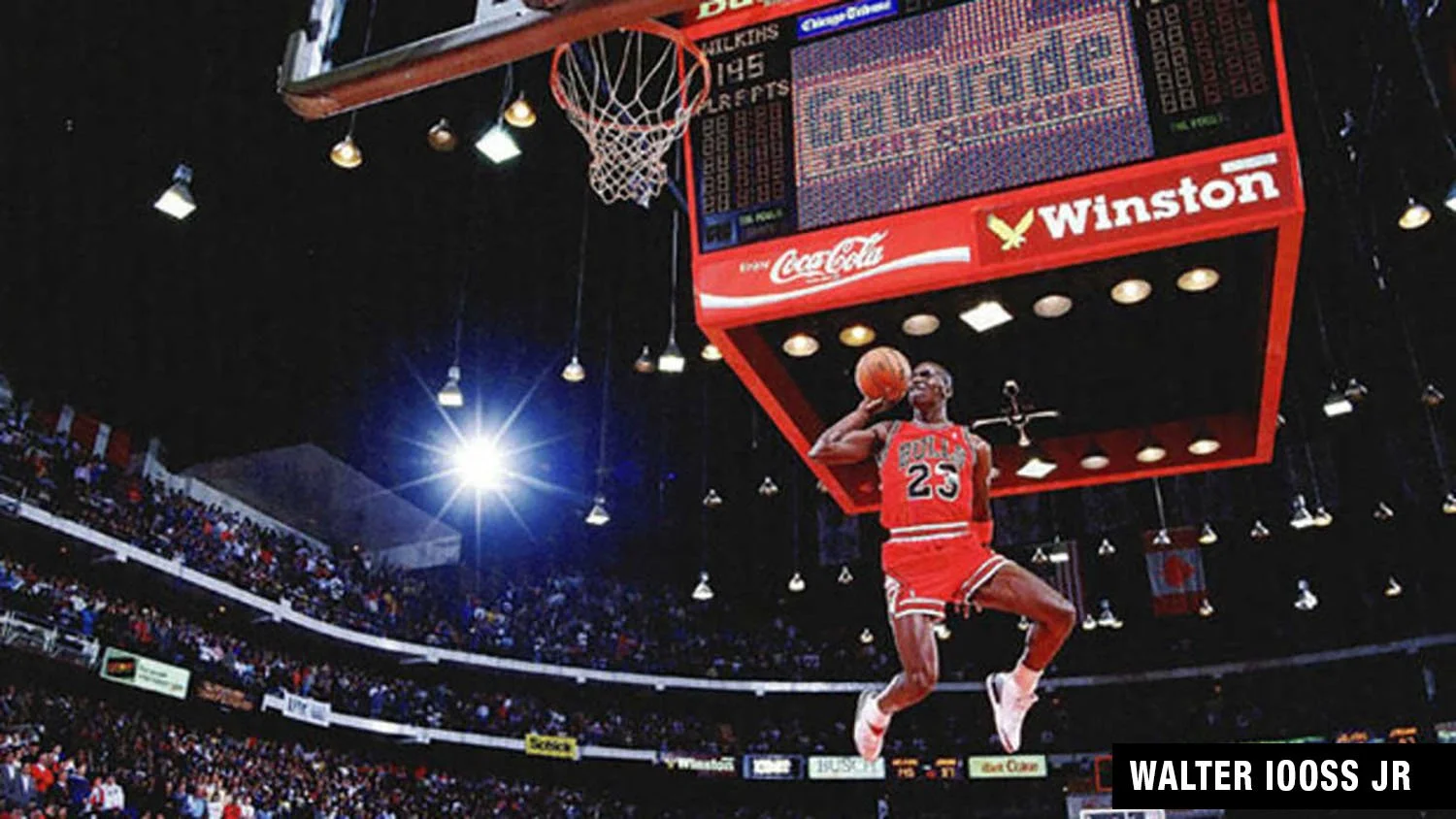
Walter Iooss Jr, 'The Slam Dunk' Michael Jordan, Chicago,1988
Impact on photography
Iooss brought a fashion photography sensibility to sports portraiture, using light, setting, and personality to elevate athletes to pop culture icons. With his crossover to Fine Art his work has been displayed in art galleries and museums worldwide. He’s also published numerous books, including:
“Athlete” (a stunning collection of portraits)
“Iooss: A Lifetime Shooting Sports”
“Heaven” (his intimate chronicle of Michael Jordan)
Iooss is also known for building real relationships with his subjects. His ability to make athletes feel at ease has led to incredibly personal, revealing images that others simply couldn’t get.
Gear: What Camera Gear Does Walter Iooss Jr. Use?
Across his long career, Walter Iooss Jr. has relied on professional Nikon and Canon DSLR systems, selecting a mix of wide-angle and telephoto lenses to suit the story he wants to tell. Iooss has also embraced specialised equipment such as underwater housings and remote-triggered camera setups, allowing him to produce striking perspectives that go beyond the traditional sidelines view.
Get access to ALL our online courses - 1000’s of videos, worksheets, critiques of students work, personalised support and much more with our monthly membership.

Hy Money
Famous Sports Photographer: Hy Money
Hy Money holds a special place in the world of sports photography—not just for the images she captured, but for the barriers she broke. As one of the first female sports photographer in the UK, she carved a path through what was then a male-dominated industry, with determination, resilience, and remarkable talent.
Famous Work: Hy Money’s most famous work isn’t just a single image — it’s a body of work that told a new kind of sports story: emotionally rich, deeply human, and often unseen through a male-dominated lens. Her big break came when she approached Crystal Palace Football Club and asked if she could photograph their matches. They said yes—and Hy became the first female sports photographer in the UK, kicking off a pioneering career that would span decades.
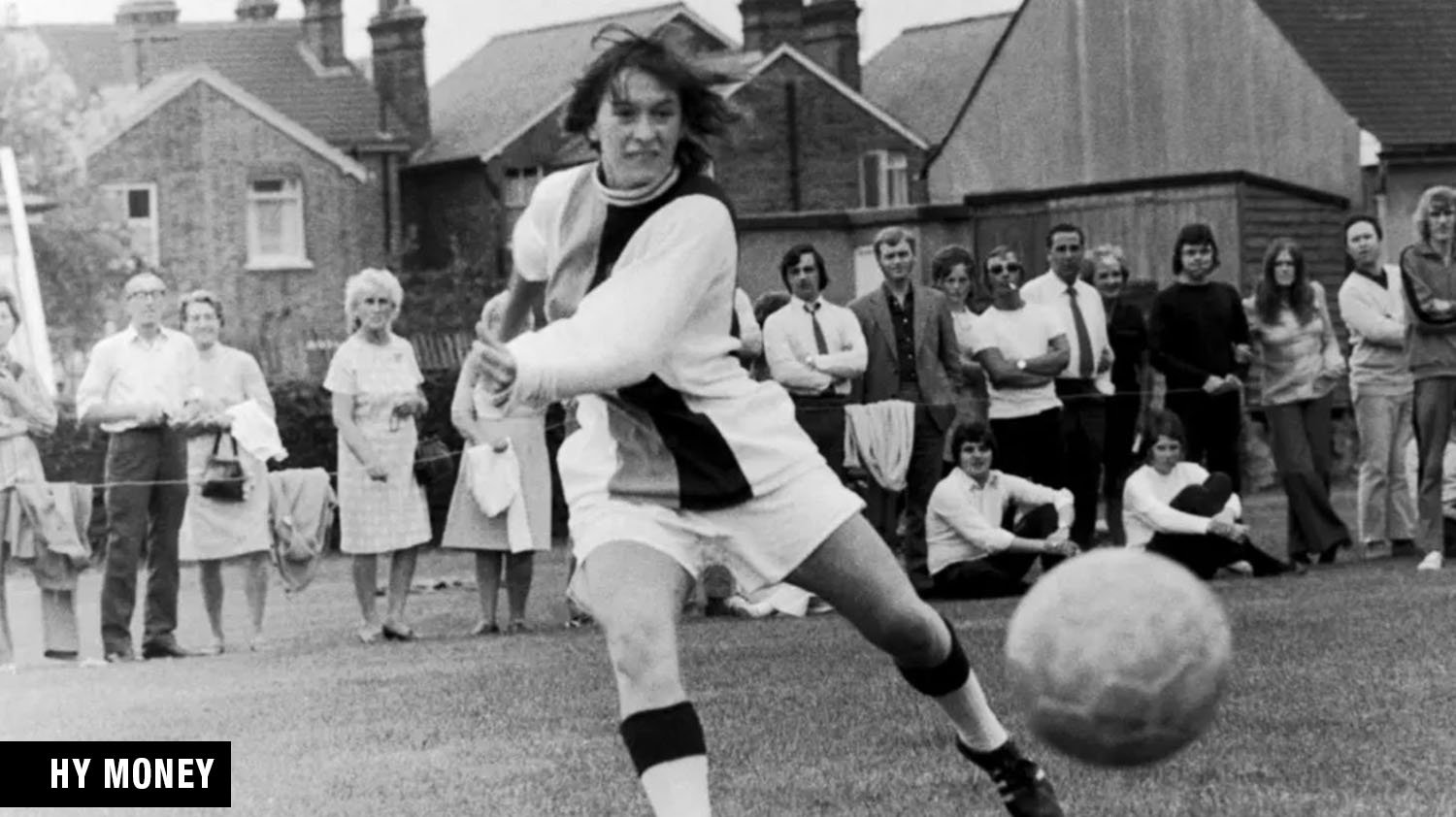
© Hy Money - Crystal Palace Ladies players in the 1970s
Early Life and Education
Born in 1937 in Bangalore, India, Money moved to the UK from India as a teenager. She originally trained as a fine artist, studying portrait painting and traditional drawing techniques in London. Though formal details about where she studied are scarce, it’s clear that her training in artistic composition, lighting, and human form deeply influenced her photographic eye later on.
She was inspired to pick up a camera while raising her children, at a time when she was seeking a creative outlet that could also fit into her life as a mother. What began as a passion quickly turned into a career.

Hy Money, Palace clinch the Women's Home Counties League title at the first attempt
Impact on photography
Hy Money’s contributions go beyond photography. She is a symbol of inclusivity and perseverance in an industry that wasn’t built to welcome someone like her—a woman, an immigrant, and a self-taught photographer.
She paved the way for future generations of female sports photographers, such as Lynne Cameron and Elsa Garrison.
Hy Money is widely recognised as the first accredited and officially recognised female football and sports photographer in the UK. At a time when pitch-side access was almost exclusively male, she secured professional accreditation and established herself as a respected presence within top-level football.
Hy’s story is one of self-made success an artist-turned-photographer who broke barriers through talent, persistence, and a keen eye for moments others often missed.
Gear: What Camera Gear Does Hy Money Use?
Throughout her career, Hy Money worked primarily with film cameras, beginning with a simple Kodak Box Brownie before progressing to a Rolleiflex twin-lens reflex camera. For more than three decades, she relied on Nikon 35mm equipment to capture professional football and major sporting events, building her pioneering career with trusted, manual film systems.
Bob Martin
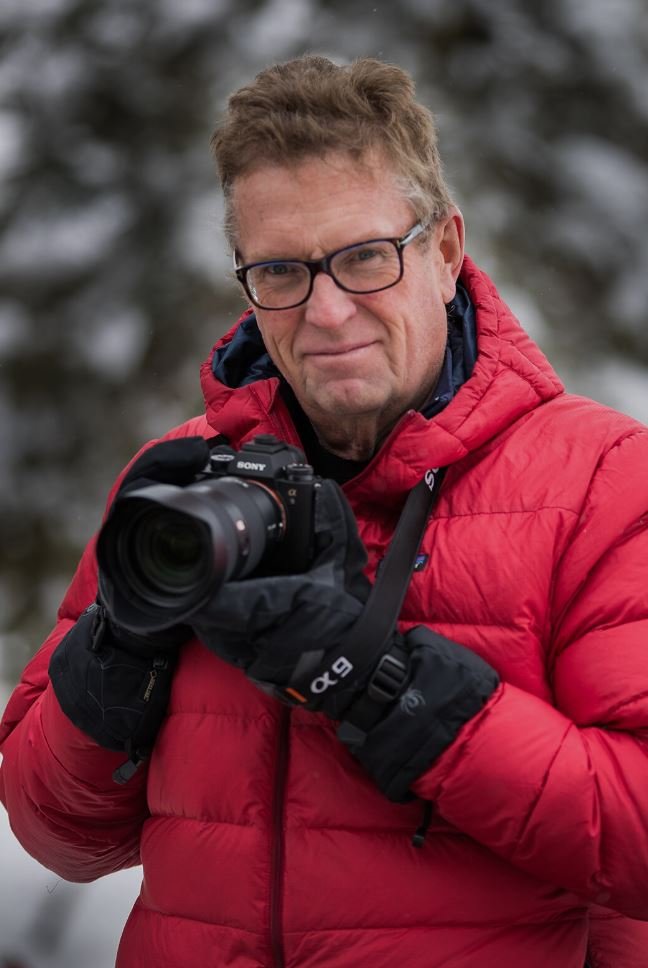
Famous Sport Photographer: Bob Martin
Bob Martin is a British multi-award-winning sports photographer renowned for his dynamic, high-impact images that capture the drama, emotion, and artistry of athletic performance. With a career spanning more than three decades and over 70 countries, Martin has covered 16 Olympic Games, countless major sporting events, and some of the most unforgettable moments in sports history.
Famous Work: The famous photo of Usain Bolt during the 200m final at the 2008 Beijing Olympics is one of the most iconic images in sports history. This moment captured Bolt's dominance, as he coasted to victory, breaking the world record in the process.
In this legendary shot, Bolt is turning his head to look at the clock, all while maintaining his incredible speed. The image symbolizes his confidence and athletic prowess. This moment not only marked his record-breaking run but also solidified his status as one of the greatest sprinters in history.
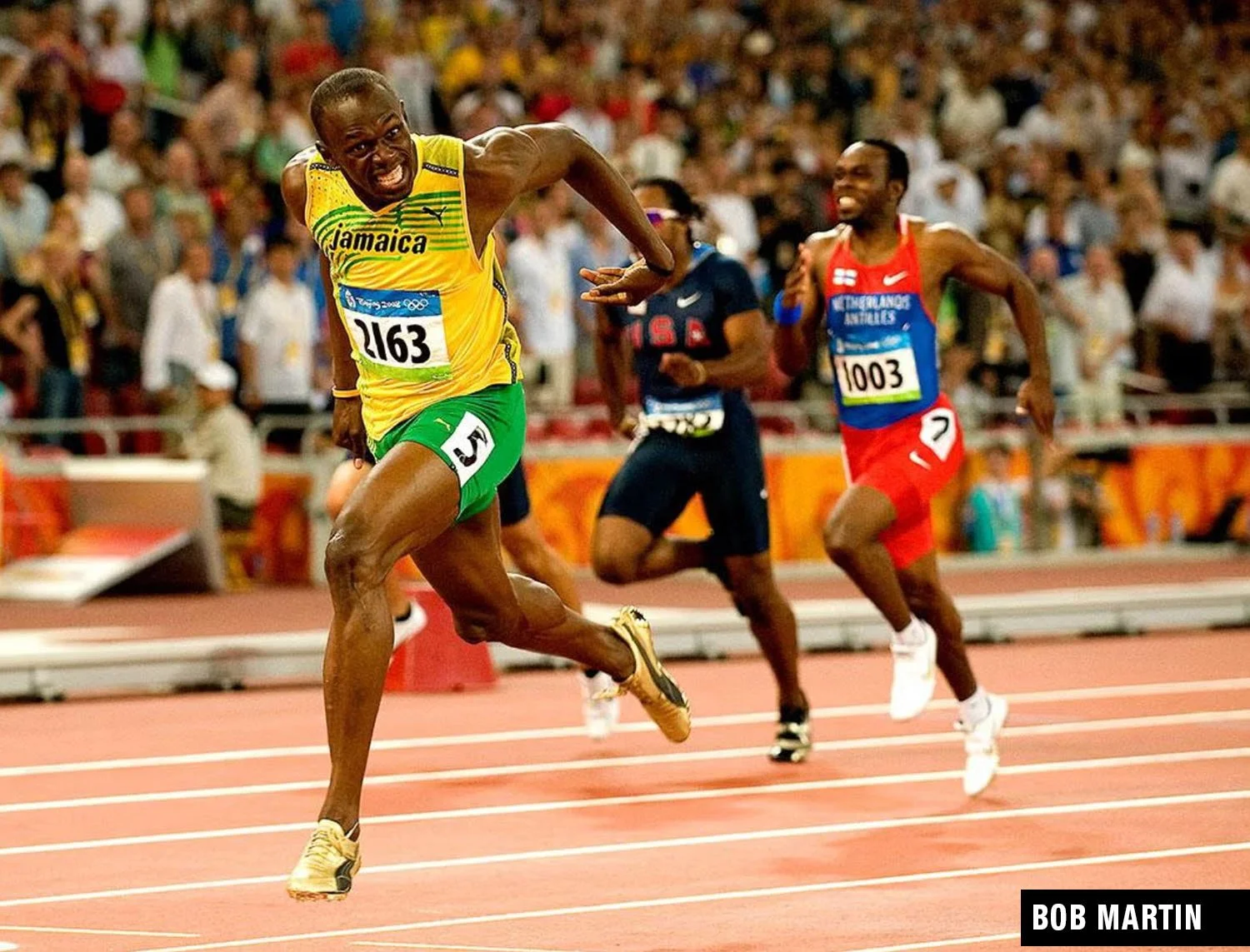
© Bob Martin - 200-meter final in Beijing
Early Life and education
Bob Martin was born in the United Kingdom in 1959. His love for photography developed early, with a particular interest in capturing sports events at school. After finishing his education, he worked as a staff photographer for various newspapers before moving into freelance photography. In the early 1980s, Martin focused on sports photography, quickly earning a reputation for his outstanding work. His ability to find fresh angles, both literal and creative, helped him break out at a time when sports photography was rapidly evolving with new technology.
His big break came as his work began appearing in major publications like Sports Illustrated, Time, Newsweek, and L'Équipe, leading to assignments around the globe.
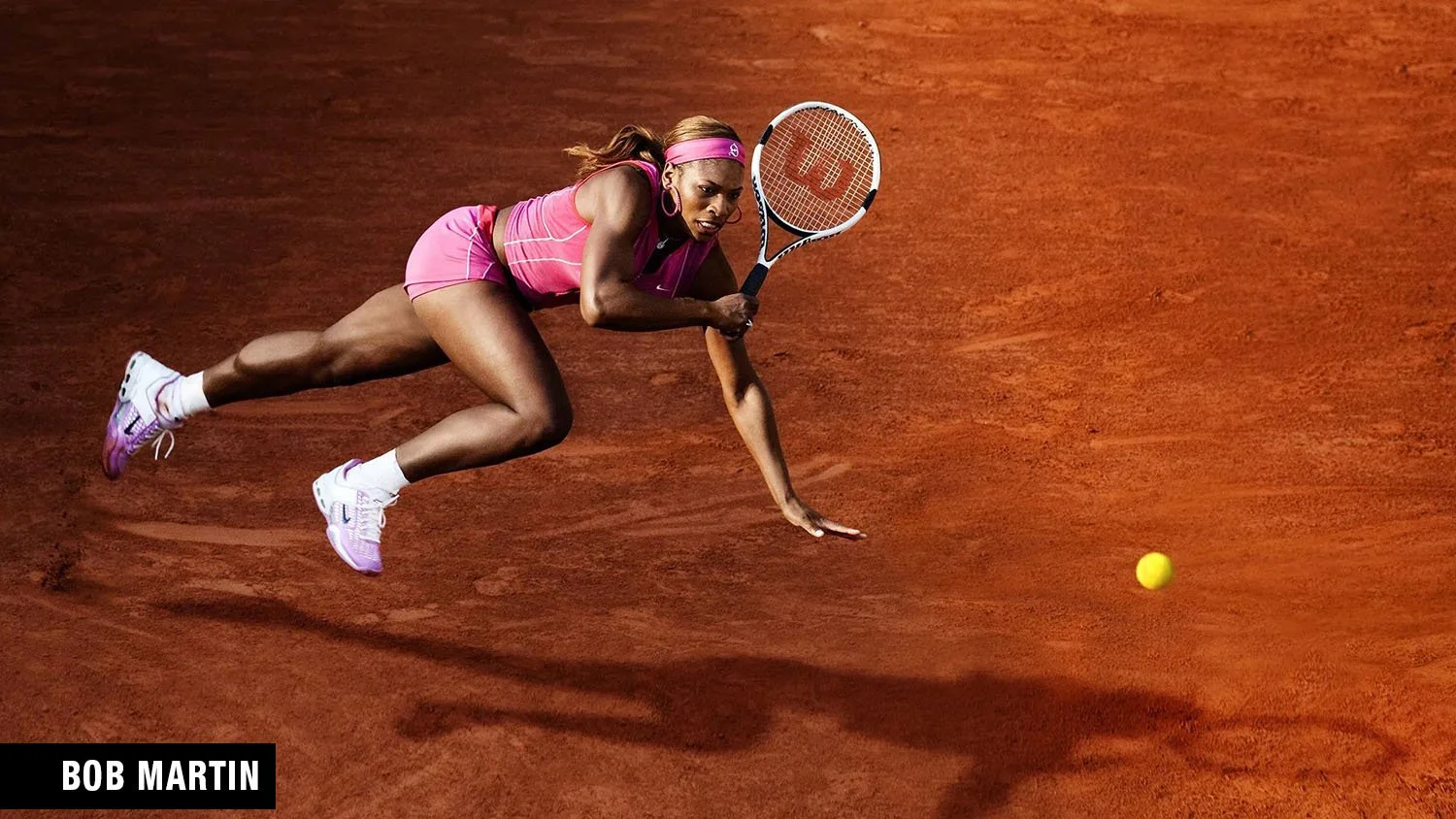
Bob Martin, Serena 2004
Impact on photography
Martin is celebrated for his unmatched technical excellence, deep understanding of sport, and creative use of lighting, framing, and location. His images often combine, motion blur with crystal-clear focus, bold colour and contrast and a strong sense of geometry, space, and rhythm. What makes his work stand out is that he doesn’t just capture action, he interprets it, giving it scale and drama. Whether it’s a diver frozen mid-air or a wheelchair athlete blazing toward the finish, Martin’s photography transforms sport into visual poetry.
Gear: What Camera Gear Does Bob Martin Use?
Throughout his career, Bob Martin has worked with professional Canon, Sony, and Nikon DSLR systems, combining wide-angle and telephoto lenses to capture both dramatic scale and pinpoint detail. To keep pace with elite competition, he relies on high-speed memory cards for rapid continuous shooting, while monopods and tripods provide stability during long events. He also incorporates off-camera flashes and strobes when needed, adding creative control and impact to his lighting in high-pressure sporting environments.
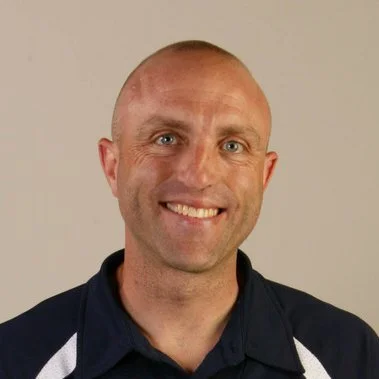
Al Bello
Famous Sport Photographer: Al Bello
Al Bello is a renowned sports photographer with over three decades of experience in capturing iconic moments in athletics. He began his career as a darkroom assistant for a local newspaper in Long Island, shooting boxing on weekends. Bello's talent and dedication led him to work for Allsport, which was later acquired by Getty Images in 1998.
Famous Work: Michael Phelps' Victory Moments. Bello has photographed Michael Phelps multiple times, including capturing moments of triumph at various Olympic Games. These images highlight Phelps' dominance in swimming and have become iconic representations of his career.
These photos exemplify Bello's ability to anticipate action, use creative angles, and leverage technology to produce extraordinary sports photography.
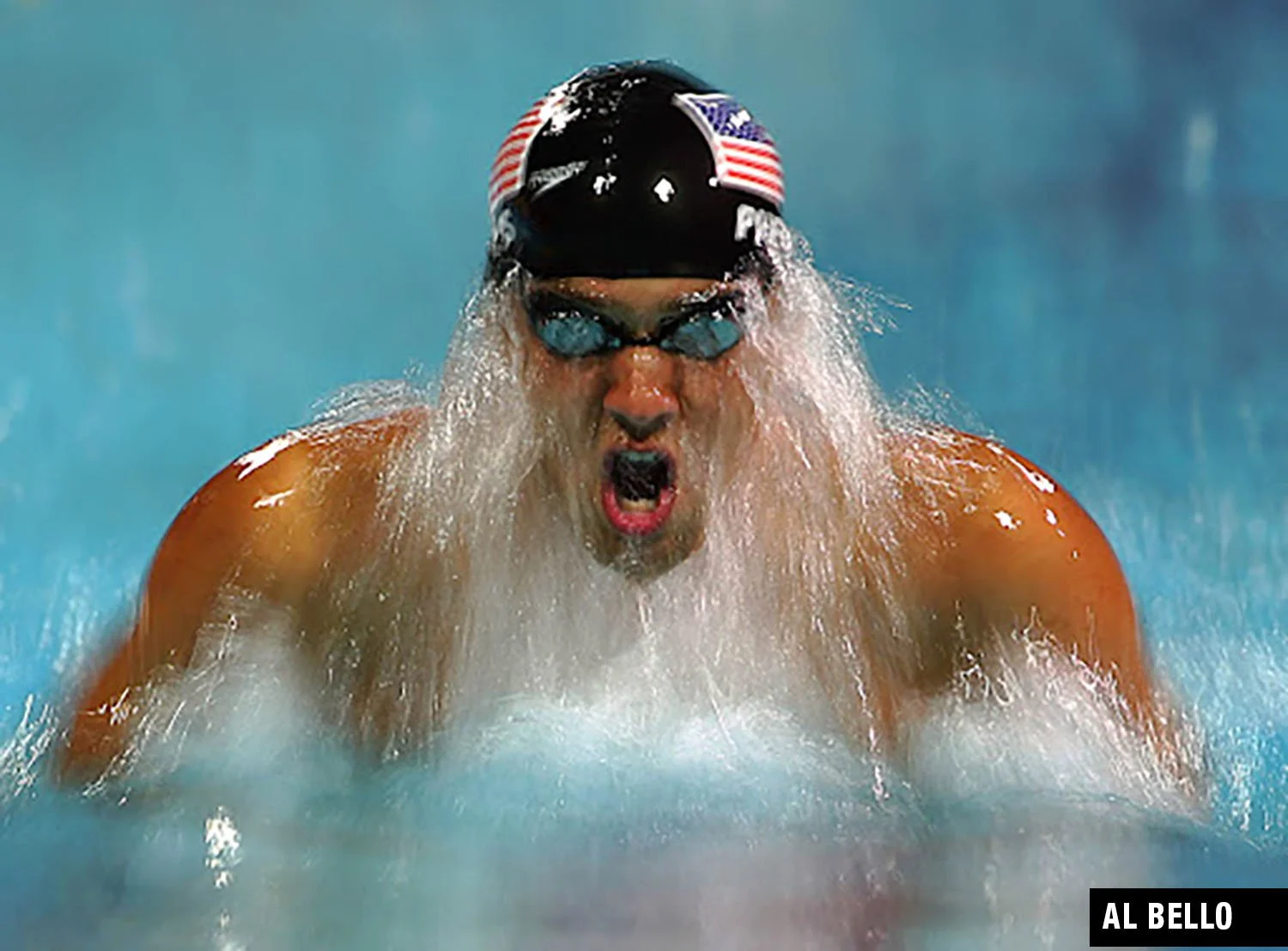
© Al Bello - Michael Phelps at the Athens Olympics 2004
Early Life and education
Al Bello was born and raised in Canarsie, Brooklyn, New York. He attended South Shore High School, where he played as a linebacker on the football team. His interest in photography began toward the end of his college years at Stony Brook University, where he graduated in 1989 with a liberal arts degree. While at Stony Brook, Bello took a photography class that sparked his passion for the craft.
After completing his education, Bello began working as a darkroom manager for The Ring boxing magazine in 1990. This role allowed him to process and print film during the week while photographing boxing events on weekends. His early experiences in sports photography laid the foundation for his future career.
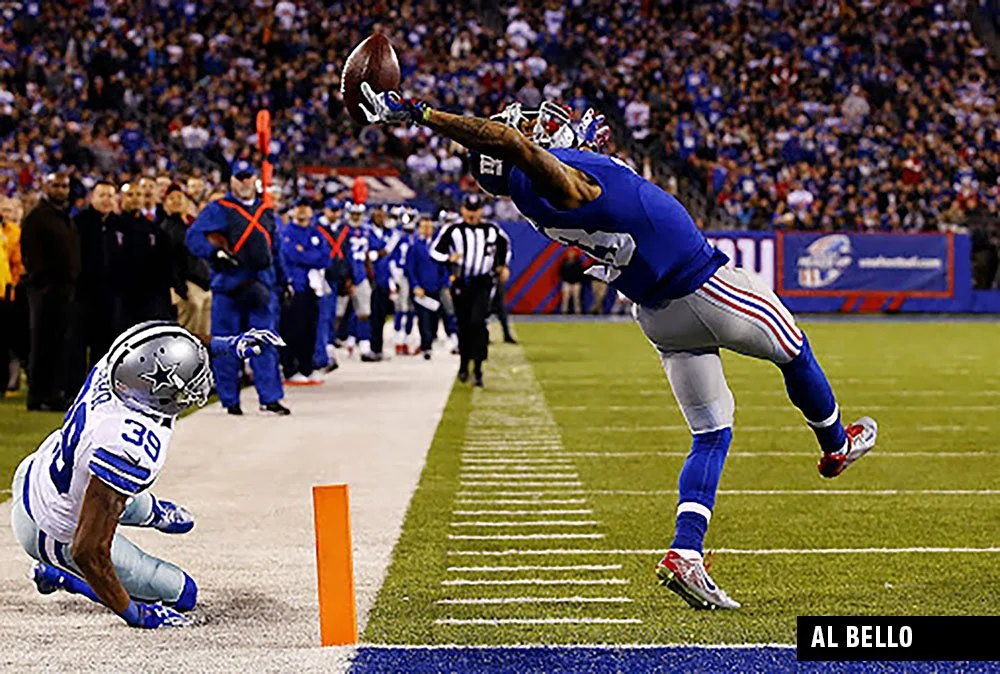
Al Bello, One-handed catch
Impact on photograph
Bello is known for his creative approach to sports photography, constantly seeking new angles and perspectives to make his images stand out. His ability to anticipate action and position himself for the perfect shot has resulted in some of the most memorable sports images in recent history. For example, his iconic photograph of Odell Beckham Jr.'s one-handed catch.
His work has inspired other photographers to push their creative boundaries and seek out unique perspectives in their own work. By consistently producing innovative and memorable images, mentoring the next generation of photographers, and pushing the technological boundaries of the field, Al Bello has left an indelible mark on the world of sports photography.
Gear: What Camera Gear Does Al Bello Use?
Throughout his career, Al Bello has relied on professional Canon camera systems, notably the Canon EOS-1D X Mark II for both field and underwater work. He typically uses fast, versatile zoom lenses such as the 200–400mm and 70–200mm f/2.8, alongside wide-angle options like the 16–35mm or 24–70mm. Bello also incorporates specialised gear including underwater housings and remote triggers to capture dynamic perspectives in high-intensity sporting environments.

Lynne Cameron
Famous Sports Photographer: Lynne Cameron
Lynne Cameron is a renowned British sports photographer known for her compelling and authentic imagery across football, Olympic sports, and international athletics. With over two decades of experience in the field, she’s one of the few women to establish a lasting and high-profile career in a male-dominated industry and her images speak volumes about emotion, movement, and the human spirit in sport.
Famous Work: Lionesses in Action - She has extensively covered the rise of the England women’s football team, from friendly matches to Euro 2022 Final, helping shape public visual perception of the modern women’s game. One of the most iconic images from the final is Chloe Kelly ripping off her shirt and running in celebration after scoring the winning goal. Lynne’s photo freezes the exact moment Kelly — filled with joy and disbelief — lifts her arms in triumph, her teammates chasing behind her. It became instantly iconic. A defining image of female athleticism, confidence, and history being made — and one that was seen across front pages around the world.s
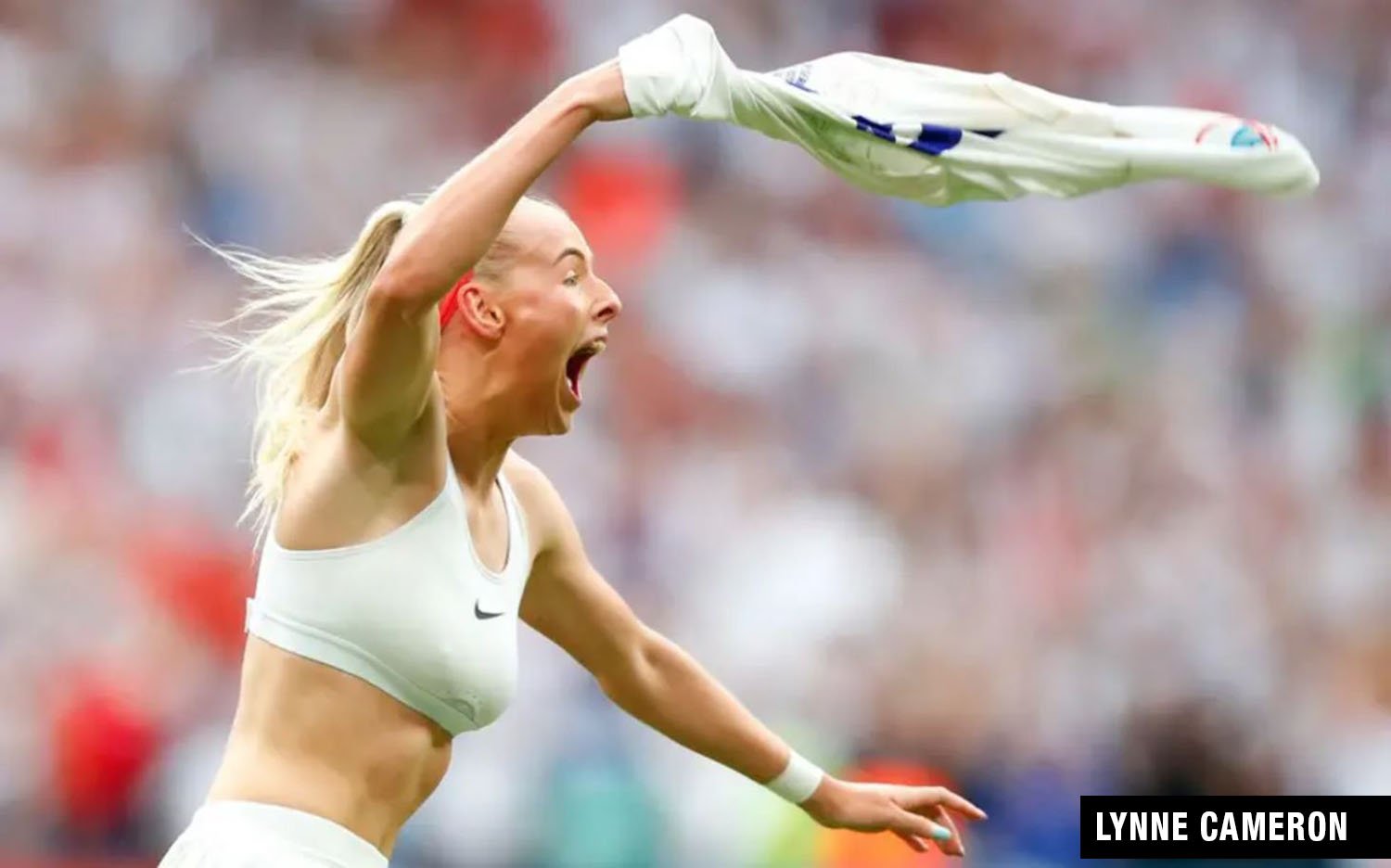
© Lynne Cameron - Chloe Kelly's iconic goal celebration 2022
Early Life and education
Cameron's early life and education were shaped by her passion for photography and her initial career aspirations. Growing up in Glasgow, she developed an interest in photography at a young age, often borrowing her father's camera to document family holidays and school events.
Despite her fascination with photography, Cameron initially pursued a different path in her education. She attended university with the intention of becoming a history teacher. However, during her second year of university, she realized that photography could be a viable career option.
Throughout her educational journey, Cameron continued to explore photography. She gained practical experience by developing pictures for a local newspaper in exchange for camera film.
As her interest in sports grew alongside her passion for photography, Cameron began to consider sports photography as a career. This led her to take on roles such as programme photographer for Greenock Morton FC and shifts at picture desks for various newspapers.
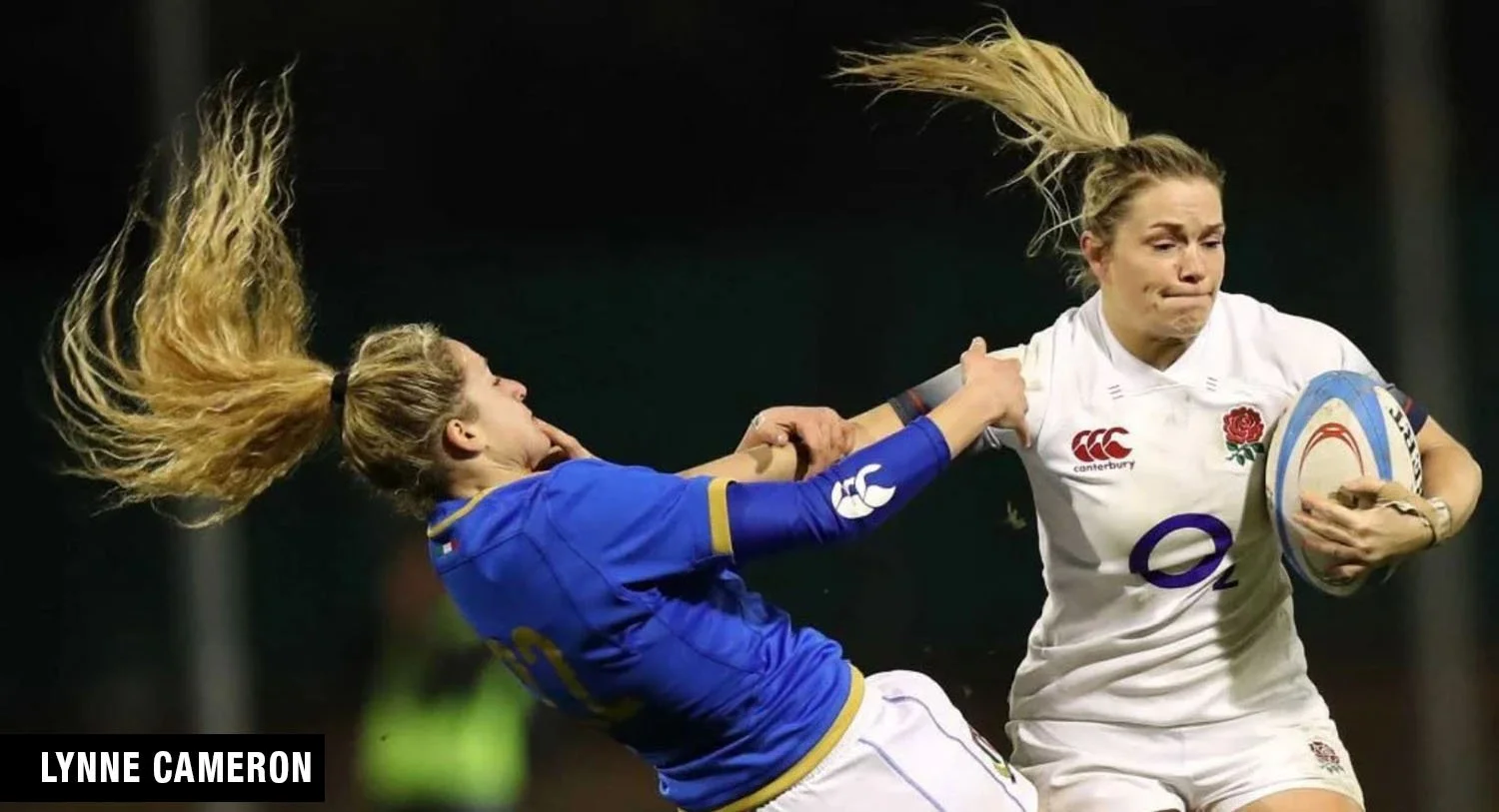
Lynne Cameron, Italy vs England
Impact on photography
Lynne Cameron has paved the way for the next generation of female sports photographers by proving that talent and timing transcend gender, visual storytelling is as important as stats and scores and authentic moments matter.
As more women enter the field of sports photography, her work continues to inspire and validate their presence.
She didn’t just shoot history; she became part of it.
Gear: What Camera Gear Does Lynne Cameron Use?
Throughout her career, Lynne Cameron has consistently relied on professional Canon camera systems, choosing to gear she trusts to deliver exceptional results under pressure. She pairs these bodies with a range of lenses suited to fast-paced sport, giving her the flexibility to capture everything from wide-angle scenes to long-range action.
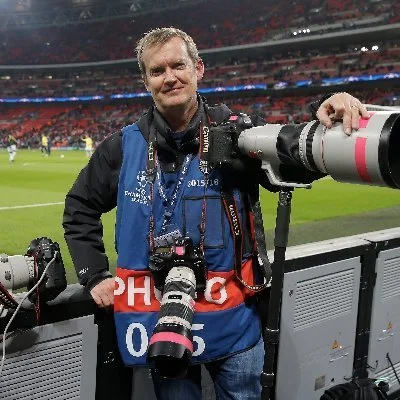
Tom Jenkins
Famous Sport Photographer: Tom Jenkins
Tom Jenkins is a multi-award-winning British sports photographer, best known for his long-standing work with The Guardian and The Observer. For over three decades, he has captured the grit, grace, and drama of global sport — from Wimbledon to the Tour de France, the Olympics to the Rugby World Cup. Jenkins has built a reputation as a storyteller with a camera, combining technical mastery with emotional depth.
Famous Work: During the 2015 Rugby World Cup, hosted in England, Tom Jenkins captured one of the most distinctive and talked-about images of the tournament: an overhead shot of a scrum, taken from high above the pitch.
The image, published in The Guardian and widely circulated across international media, has become a signature example of Jenkins’ ability to elevate a familiar sports moment into a piece of visual art. It stands as one of the defining sports images of the 2010s.

© Tom Jenkins - Rugby World Cup 2015 match between Wales and Fiji in Cardiff
Early Life and education
Jenkins was born in 1968 in Kent, England. His early life was marked by a passion for sports, although he admits that his athletic abilities did not match his enthusiasm.
Jenkins' formal education in photography began when he enrolled in the two-year diploma course in documentary photography at Newport Gwent College of Higher Education (now known as the University of South Wales) from 1987 to 1989. During this time, he studied under the guidance of photographer David Hurn
After completing his education at Newport, Jenkins embarked on his professional career. He initially worked as a freelance photographer for various organizations, including the agency Allsport and newspapers such as The Independent and Sunday Telegraph. His talent was quickly recognized, and in 1990, he received the Young Press Photographer of the Year award. This accolade marked the beginning of a successful career that would see him become a regular photographer for The Guardian in 1990 and later for The Observer in 1993.
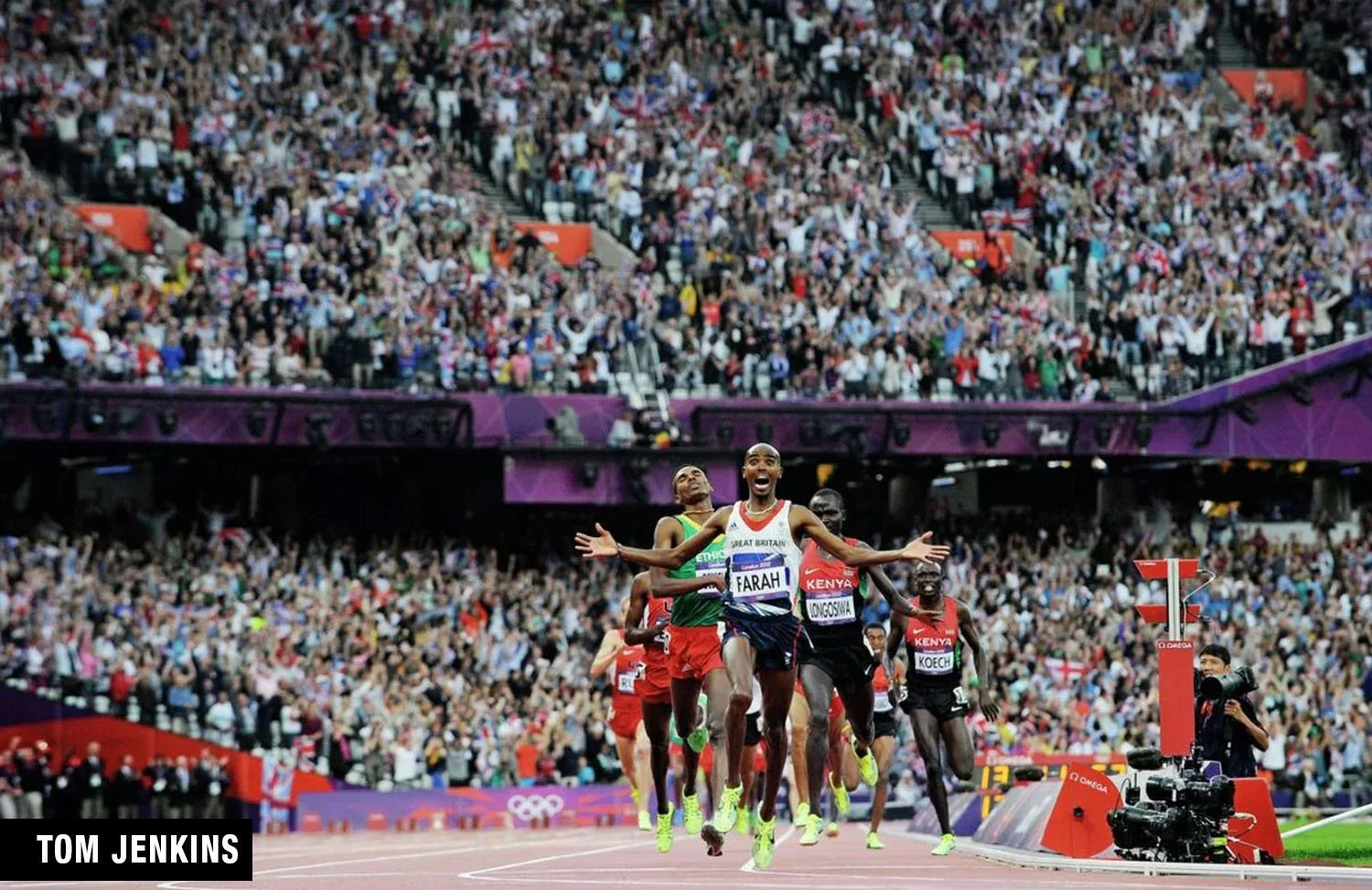
Tom Jenkins, Mo Farah wins 5000m Gold 2012
Impact on photography
Tom Jenkins has helped redefine modern British sports photography. He has inspired a generation of younger photographers by showing that sport can be art. Elevating the emotional and narrative power of live-action photography and advocating for visual storytelling in journalism, even in the era of video and real-time content
His work isn't just celebrated in sporting circles — it's studied in photojournalism, art, and cultural history.
Gear: What Camera Gear Does Tom Jenkins Use?
Throughout his career, Tom Jenkins has worked with professional Canon camera systems, often carrying multiple bodies to keep up with fast-moving sport. His core setup typically includes a Canon EOS-1D X Mark II paired with a range of L-series lenses — from the versatile 70–200mm f/2.8 and powerful 400mm f/2.8 to standard zooms like the 24–70mm and wide-angle 16–35mm — giving him flexibility for action, features, and tight-in moments. He also uses pro-grade accessories such as off-camera Speedlites, transmitters, and extenders to ensure reliable performance and creative control in demanding sports environments.
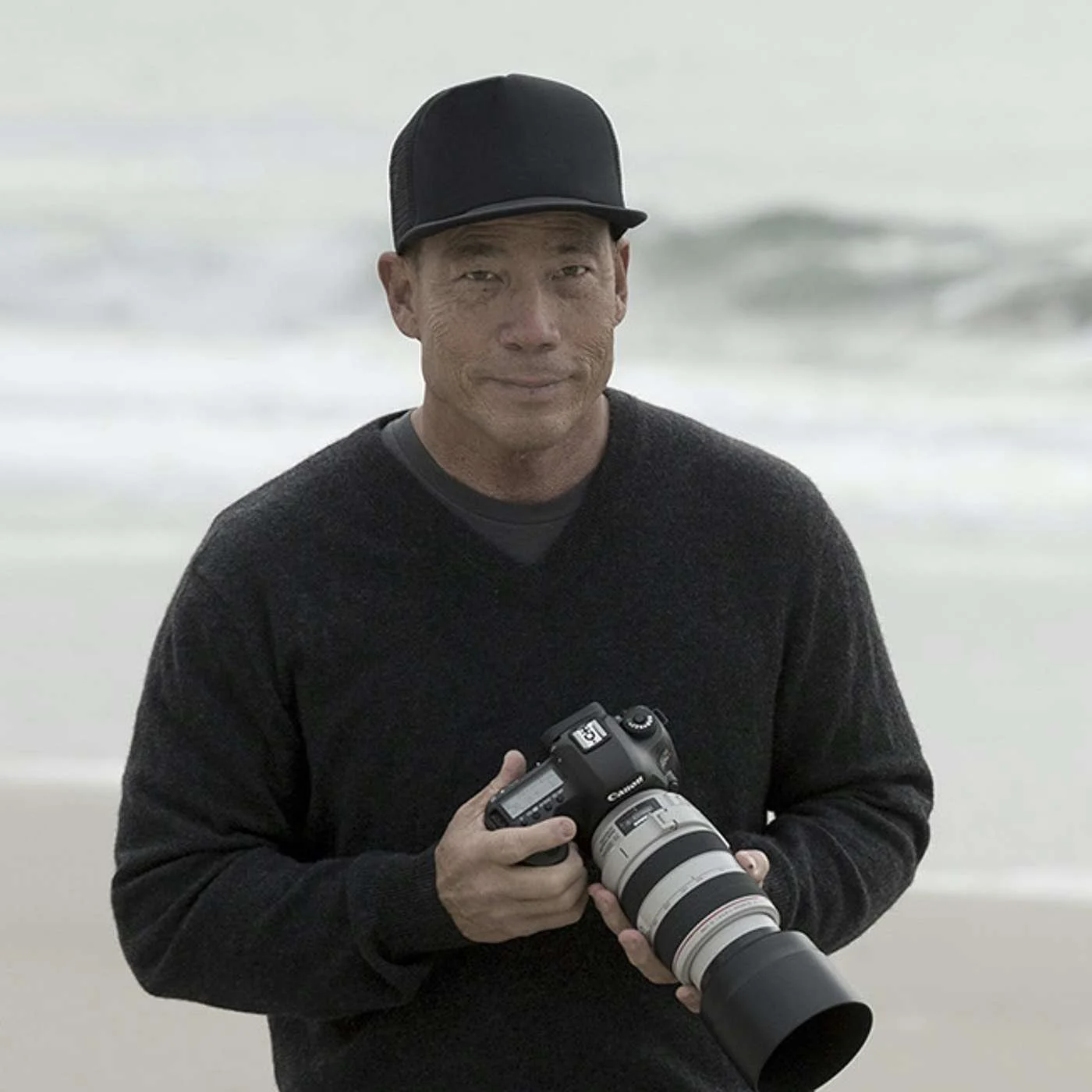
Aaron Chang
Famous Sports Photographer: Aaron Chang
Aaron Chang is a legendary American photographer best known for his iconic images of surfing, ocean landscapes, and action sports. With a career spanning over four decades, Chang has transformed the way we see surf culture — not just as a sport, but as an art form and way of life.
He is widely credited with pioneering modern surf photography, bringing a cinematic and immersive quality to a genre once dominated by wide, distant shots.
Famous Work: Kelly Slater Portraits: Chang has photographed 11-time world champion Kelly Slater throughout his career. His portraits capture not just Slater’s athletic ability, but his intensity and spiritual connection to surfing. s

© Aaron Chang - Kelly Slater Portraits
Early Life and education
Aaron Chang was born 9th August 1956 in in Tucson, Arizona. At the age of 10, Chang experienced his first ride on an air mat in the ocean, which sparked his passion for surfing. When he was 11, his family moved to California, where surfing became an all-encompassing passion for him. Chang's early education in photography began in high school when he started experimenting with a Super 8 movie camera borrowed from a friend's father. This experience ignited his interest in capturing surf footage. He later attended two semesters of junior college photo classes to further develop his skills.
At the age of 17, Chang moved to Hawaii, specifically to the North Shore of Oahu, which was considered the centre of the surfing universe. In Hawaii, he built a water-housing for his camera and produced a feature-length 8mm surf movie. Chang's formal education in photography was largely hands-on. His breakthrough came when he met Larry Moore at Surfing Magazine, which led to a 25-year tenure as Senior Photographer with the publication.
Throughout his early life, Chang faced challenges, including racial teasing in school due to his Asian features. However, he found solace and acceptance in the surfing community, where ability mattered more than ethnicity.
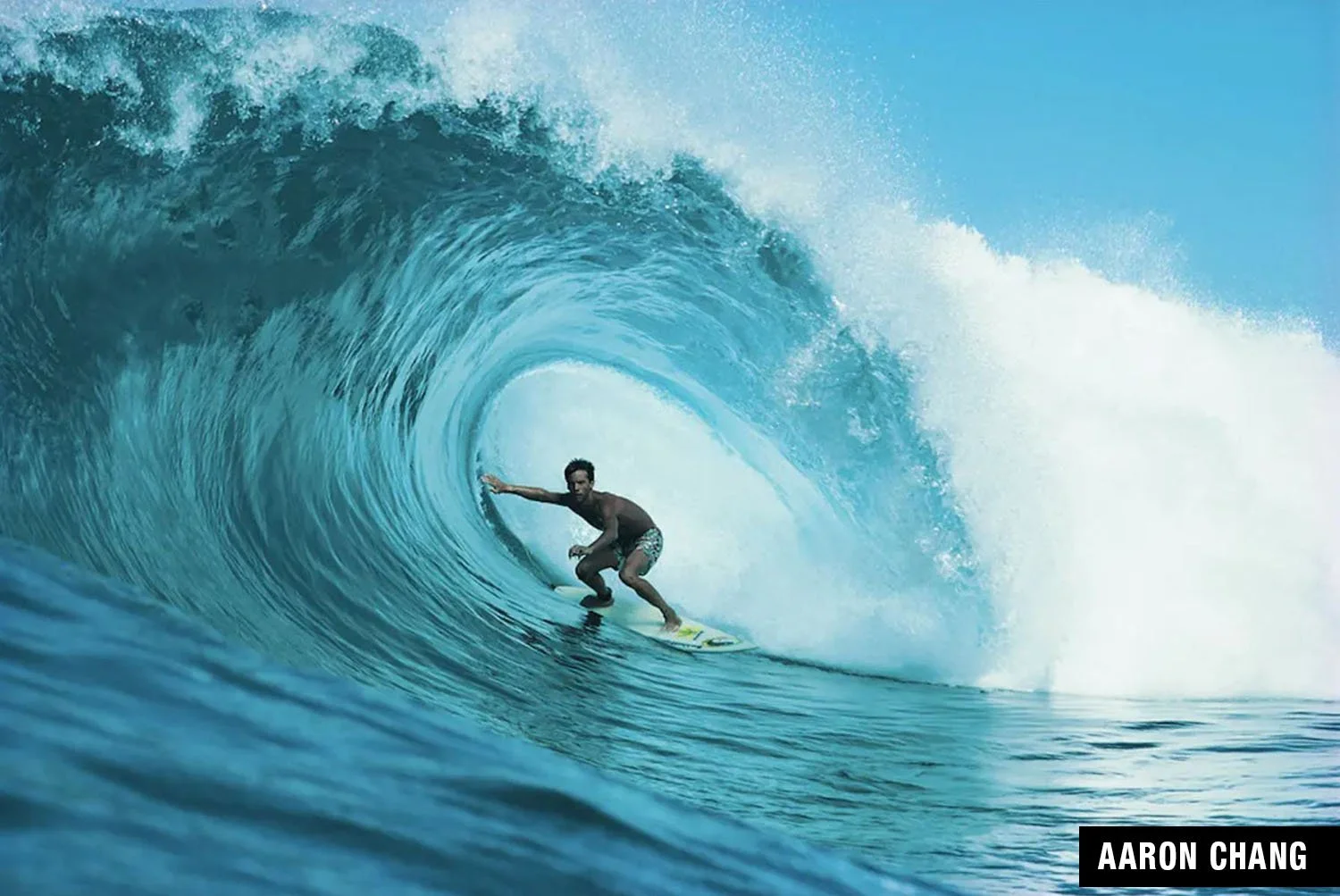
Aaron Chang, Mondragon Sunset
Impact on photography
Aaron Chang has done more than just take beautiful pictures — he helped shape the identity of modern surf culture. His work has influenced generations of surf and action sports photographers. Elevated surf photography to fine art, helped bridge the gap between athleticism and aesthetics and Inspired people to respect and revere the ocean.
Gear: What Camera Gear Does Aaron Chang Use?
Throughout his career, Aaron Chang has worked with both Olympus and Canon professional camera systems, tailoring his gear to the demands of surf photography. For in-water shooting, he frequently uses Olympus OM-D cameras housed in custom acrylic water housings, often paired with fisheye lenses to achieve immersive, inside-the-wave perspectives. For high-speed action from land, he has relied on Canon DSLRs such as the EOS-1D Mark II and 1D X Mark II, commonly using the EF 70–200mm f/2.8L IS II USM lens. His equipment choices prioritise durability, speed, and the ability to capture dynamic ocean environments.
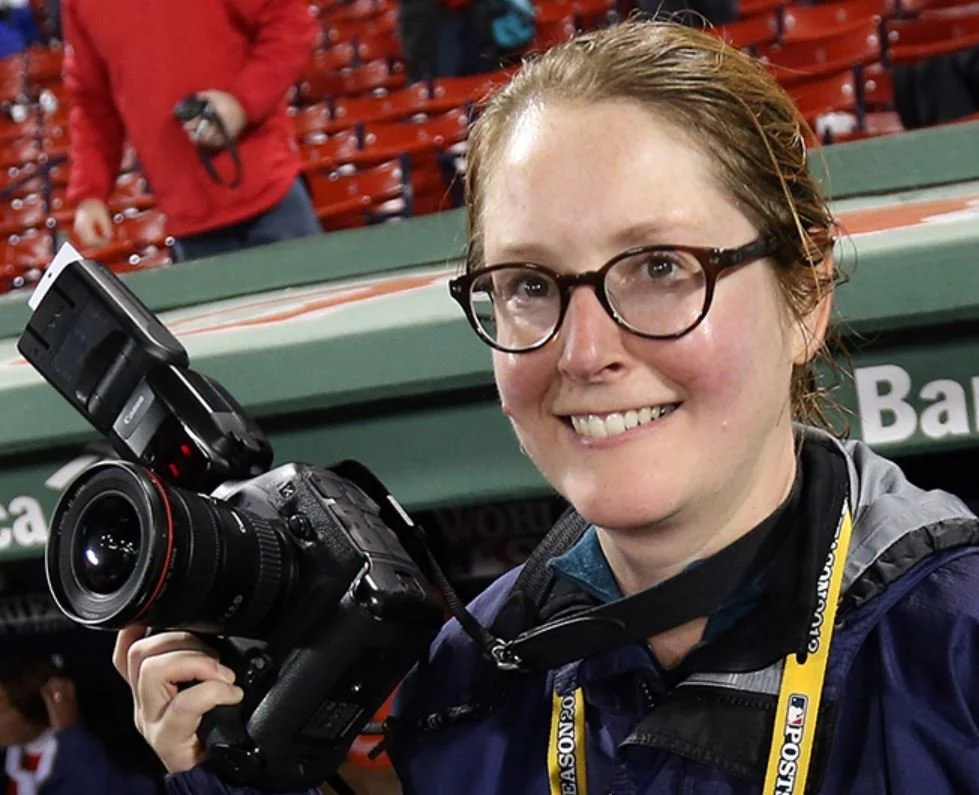
Elsa Garrison
Famous Sport Photographer: Elsa Garrison
Elsa Garrison is an acclaimed American sports photographer whose work spans decades and encompasses some of the most iconic events and athletes in modern history. As one of the few prominent women in a male-dominated industry, Garrison has built a career marked by precision, versatility, and quiet excellence.
Working for Getty Images, Garrison has not only documented the action but shaped the way we experience and remember sports.
Famous Work: At the 2024 Paris Olympics, photographer Elsa Garrison captured an iconic image of U.S. gymnasts Simone Biles and Jordan Chiles bowing down to Brazilian gold medallist Rebeca Andrade on the medals podium during the women's gymnastics floor exercise event. This powerful photograph quickly became one of the most memorable images of the Olympic Games, embodying the spirit of sportsmanship and mutual respect among athletes.

© Elsa Garrison - U.S. Gymnastic Team bow down on the podium to gold medal winner from Brazil
Early Life and education
Elsa Garrison's early life and education were shaped by her passion for photography, which began in her hometown of Brainerd, Minnesota. Her journey in photography started in 9th grade when she took a photography class as an art elective. This class sparked her interest in the technical aspects of creating images and led her to work on the high school yearbook throughout the rest of her high school years.
In 10th grade, Garrison participated in a mentorship program that paired her with the local newspaper photographer. This experience exposed her to sports photography, as most of her assignments were on nights and weekends due to her school schedule. By the summer after her sophomore year, the Brainerd paper offered her a job, working full-time during summers and part-time during the school year.
After graduating from Brainerd High School in 1990, Garrison initially attended the University of Minnesota, where she worked for the athletic department and freelanced for the Associated Press. However, following recommendations from colleagues, she transferred to the University of Missouri, Columbia, as a sophomore to study photojournalism at the Missouri School of Journalism.
At the University of Missouri, Garrison pursued a degree in journalism, which provided her with a strong foundation in visual storytelling and the principles of photojournalism. This education, combined with her early experiences in Brainerd, set the stage for her successful career as a sports photographer.
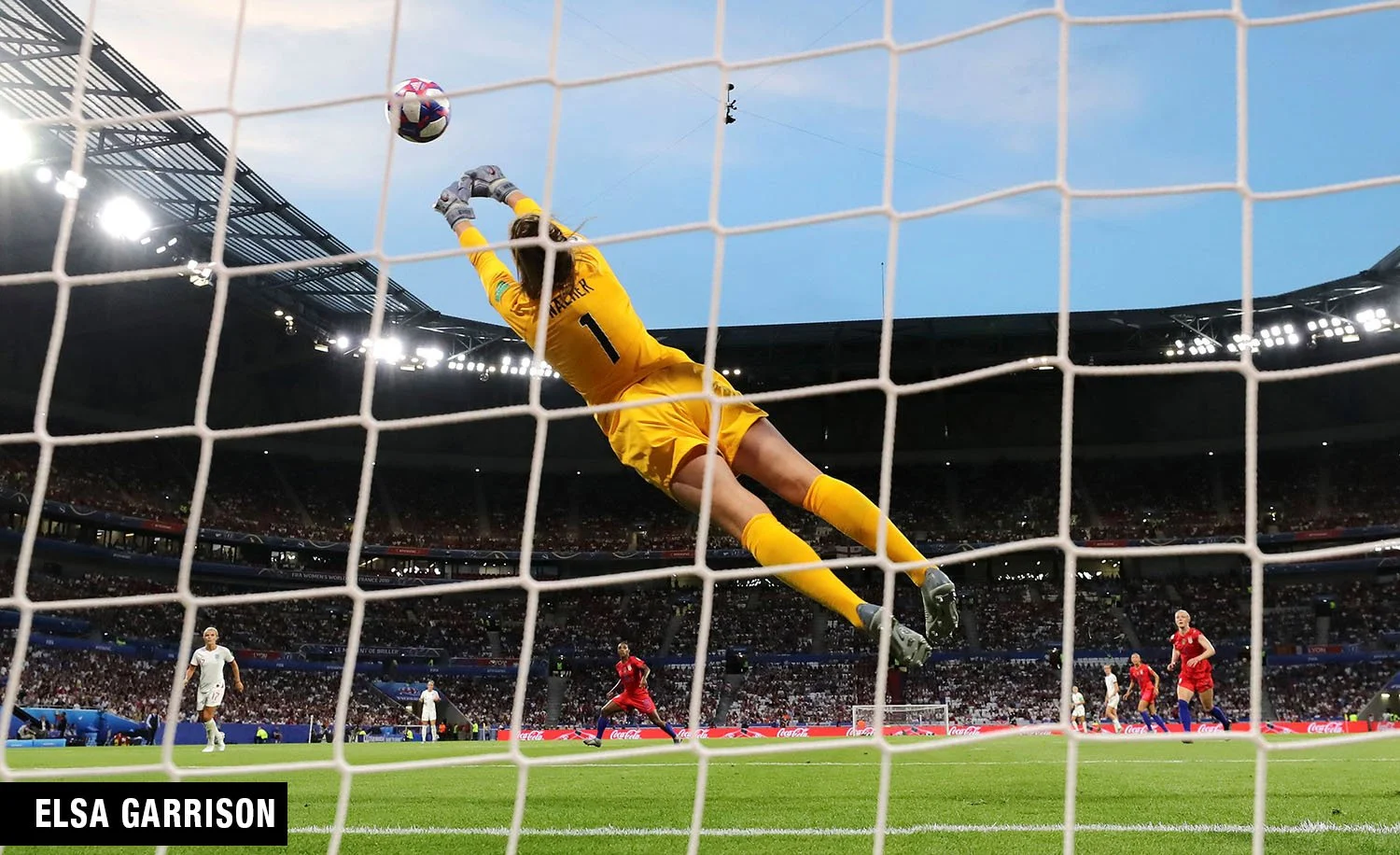
Elsa Garrison, Alyssa Naeher
Impact on photography
As a sports photographer, Elsa’s work has influenced a new generation of photographers — especially women — who see in her career a model for excellence, perseverance, and artistic vision in a challenging industry.
She has spoken about the importance of diversity on the sidelines and continues to be an advocate for inclusive storytelling in sports media.
Gear: What Camera Gear Does Elsa Garrison Use?
Throughout her career, Elsa Garrison has relied on professional Canon camera systems, including the EOS R3 mirrorless and the EOS-1D X Mark III DSLR. She works with a range of fast telephoto, standard zoom, and wide-angle lenses, often carrying multiple bodies to ensure she captures decisive sporting moments without hesitation.
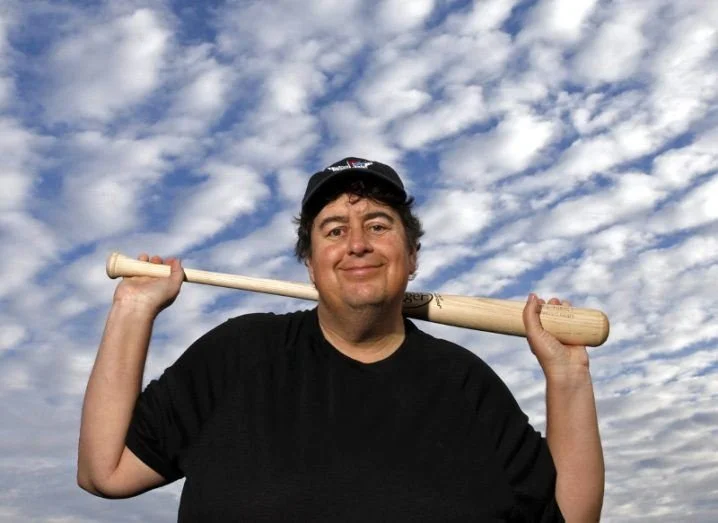
Brad Mangin
Famous Sport Photographer: Brad Mangin
Brad Mangin is a veteran American sports photographer known primarily for his extensive and passionate coverage of baseball — especially Major League Baseball (MLB). With a career spanning over three decades, Mangin has built a visual legacy that blends action, storytelling, and a deep emotional connection to the game.
Often referred to as a "baseball purist with a camera," Mangin’s imagery captures not just the thrill of a home run or a key play at second base, but the rhythm, romance, and rituals of the sport. From the dugout to the outfield, his lens offers fans a timeless view of America’s pastime.
Famous Work: San Francisco Giants’ World Series Runs - His intimate, behind-the-scenes coverage of the 2010, 2012, and 2014 Giants championship teams is beloved by fans. He captured everything from locker room celebrations to quiet dugout moments with cinematic warmth and authenticity.
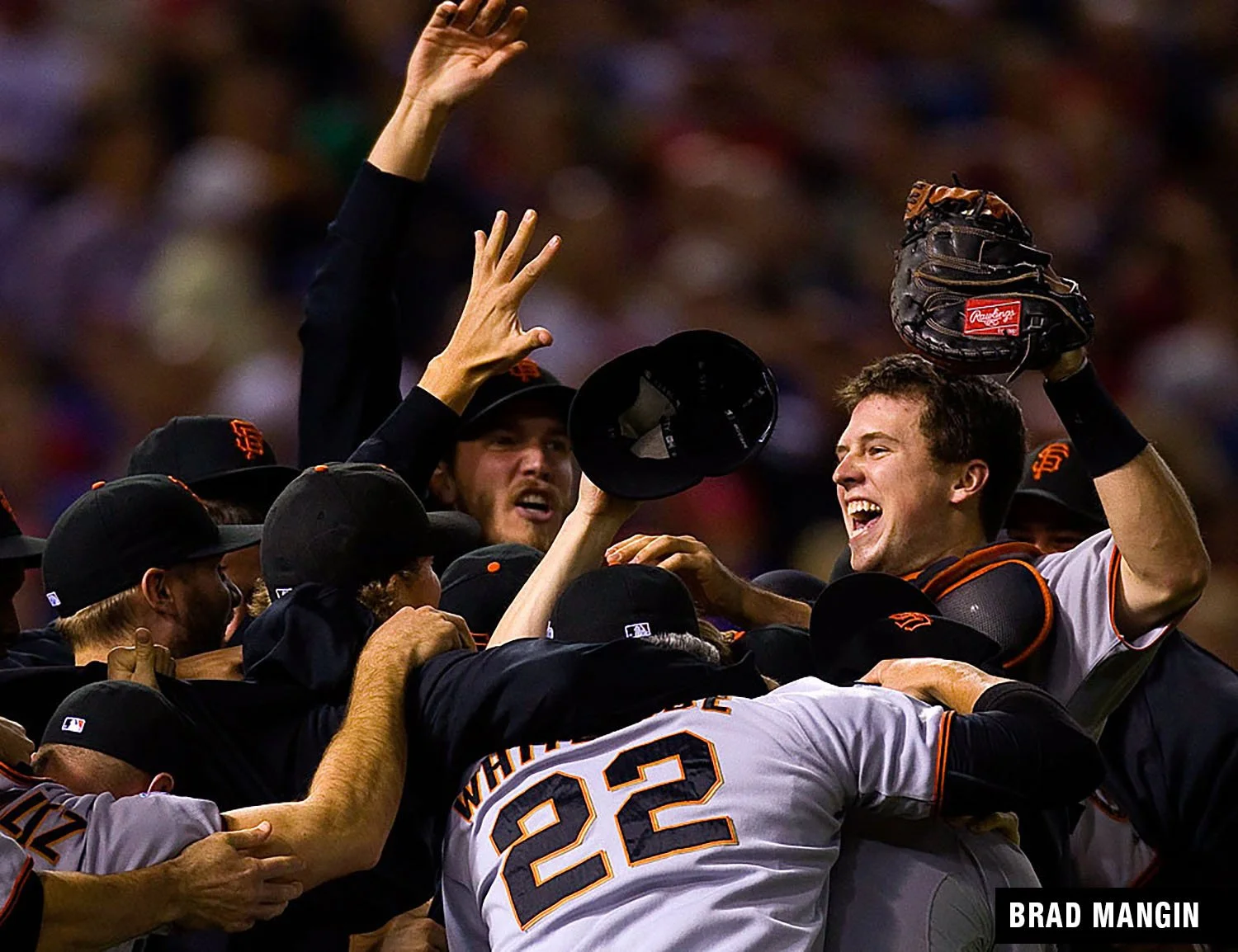
© Brad Mangin - 2010 World Series Celebration
Early Life and education
Mangin grew up in Fremont, California, in the San Francisco Bay Area. His early interest in photography began during his junior year of high school at Washington High School in Fremont. His best friend, Joe Gosen, encouraged him to take a basic photography class taught by Paul Ficken. This experience sparked his passion for photography, especially working with black-and-white film and developing prints in the darkroom. During this time, Mangin saved money from part-time jobs, such as washing dishes and working at Chuck E. Cheese, to purchase his first camera, a Canon AE-1 Program, in 1982.
Mangin's love for photography continued to grow as he joined the yearbook staff in high school and later attended Ohlone College in Fremont. At Ohlone, he worked for the college newspaper The Monitor and decided to pursue photojournalism. After earning an associate degree, he transferred to San Jose State University (SJSU) in 1986 to study photojournalism under esteemed professors Joe Swan and Jim McNay. At SJSU, Mangin gained invaluable experience working for the university's student newspaper, The Spartan Daily. He graduated with a degree in photojournalism in 1988.
Mangin's early education and experiences laid the foundation for his successful career as a sports photographer.

Brad Mangin, Joe Torre and the New York Yankees win the World Series at Shea Stadium in Queens, New York in October of 2000
Impact on photography
Mangin is more than a sports photographer — he’s a baseball historian with a camera. His commitment to capturing the essence of the game — not just its stats or highlights — has earned him a reputation for deep storytelling in every frame with a masterful blend of sports and documentary photography.
Gear: What Camera Gear Does Brad Mangin Use?
Throughout his career, Brad Mangin has relied primarily on professional Canon camera systems, often shooting with EOS-1D X bodies paired with fast, high-performance lenses such as the 400mm f/2.8L IS II USM and 70–200mm f/2.8L IS II USM to capture dynamic sports action. Earlier in his career, he also worked with Nikon film cameras before transitioning fully to Canon digital systems. In addition to his traditional camera gear, Mangin is known for incorporating iPhones into his professional workflow for social media and select publications, blending established pro equipment with modern storytelling tools.
What Camera Gear Do Leading Sport Photographers Use?
While each of these Famous Sports Photographers has their own style, most professionals rely on:
· Professional DSLR or mirrorless cameras (Canon, Nikon, Sony)
· Fast telephoto lenses (70–200mm, 300mm, 400mm, 600mm)
· High burst rates (20+ fps for peak action)
· Fast autofocus tracking systems
· High shutter speeds (1/1000s or faster)
· Dual memory card slots for reliability
Modern sports photographers also increasingly use:
· Mirrorless cameras for silent shooting - Best Canon Mirrorless Camera - Which one for you?
· Remote cameras positioned behind goals or above courts
· Weather-sealed gear for extreme environments
FAQ – Famous Sport Photographers
Who is the most famous sport photographer?
Neil Leifer and Walter Iooss Jr. are often considered among the most famous sports photographers due to their iconic Sports Illustrated work.
What camera gear do famous sport photographers use?
Most leading sport photographers use professional Canon, Nikon, or Sony cameras paired with fast telephoto lenses such as 70–200mm, 300mm, or 400mm lenses.
Best Professional Cameras for under £1000!
How do I become a sports photographer?
Start by mastering shutter speed, autofocus tracking, and composition. Building a portfolio and capturing local sporting events is essential.
Want to learn how to control every aspect of your photography properly? Click here to check out our beginner’s photography course
Conclusion
From historic punches in the ring to triumphant goals and surf culture’s soul, these Famous Sports Photographers have shaped how we see sport. They not only capture unforgettable moments but inspire photographers worldwide with their vision and technical mastery.
Want to elevate your own sports photography? Get access to all our online courses — thousands of videos, worksheets, and personalised support — with our membership.
Learn more, shoot better, and become part of the next generation of iconic sports photographers.
Check out these tutorials below


I hope you liked this blog on the top 10 sports photographers of our time, please leave us a comment, and support us by sharing it with your friends and subscribe to our newsletter at the bottom of this page for more.
We also have an excellent learning community on social media so please join us there as well.
Thanks for reading and remember – Learn more at The School of Photography.
