
How to Photograph Fireworks – A Complete Guide to Photographing Fireworks at Night
In this tutorial, I’ll show you how to photograph fireworks with confidence, even if you’ve never tried it before. You’ll also receive a FREE Fireworks Photography Guide that you can take with you on your shoot, making it easy to follow along on the night.
Photographing fireworks is often easier than people expect. With the right camera equipment, the correct fireworks photography settings, and a basic understanding of composition and long-exposure techniques, you can capture sharp, colourful images that truly stand out.
In this guide, you’ll learn how to:
Set up your camera for photographing fireworks at night
Use manual camera settings to capture sharp, vibrant fireworks
Expose correctly while adding creative foreground interest
We’d love to see your fireworks photography inspired by this tutorial. Tag us on Instagram and Twitter #theschoolofphotography, or on Facebook @theschoolofphotography1.
If you enjoy photographing fireworks, you may also find our Sparkler Photography Tutorial useful, as it explores similar long-exposure and night photography techniques.
Download our free guide below.
Get access to ALL our online courses - 1000’s of videos, worksheets, critiques of students work, personalised support and much more with our monthly membership.
Firework Photography Camera Settings: (Manual Mode)

Nitish Meena on Unsplash
To get sharp, colourful results when photographing fireworks, your camera needs to be in Manual mode (M).
Recommended Camera Settings for Photographing Fireworks
Aperture: f/22
Shutter Speed: 15 seconds (perfect for capturing fireworks bursts)
ISO: 100
Focus: Manual focus set to infinity
These firework photography settings allow you to capture multiple bursts using long exposure photography while keeping noise to a minimum.
Essential Equipment for Photographing Fireworks
Using a Tripod for Fireworks Photography

A sturdy tripod is essential when photographing fireworks to keep your camera stable during long exposures.
When photographing fireworks at night, your camera must remain completely still.
A strong, sturdy tripod is essential to avoid motion blur during long exposures.
Avoid cheap or flimsy tripods as they can move in wind and ruin your shots.
DSLR or Mirrorless Cameras with Manual Controls

A DSLR or mirrorless camera with manual controls gives you full control when photographing fireworks.
To successfully capture fireworks, you need a camera that supports full manual control.
A DSLR or mirrorless camera is ideal for photographing fireworks because it allows you to control:
Shutter speed
Aperture
ISOTo learn how to use your camera in fully manual mode click here.
Remote Shutter Release or Cable Release

Using a remote trigger or cable release helps prevent camera shake when photographing fireworks.
When photographing fireworks, do not touch the camera during exposure.
Using a remote trigger or cable release prevents camera shake and ensures sharp results.
Wide Angle and Standard Lens

Wide-angle and standard lenses are ideal choices for photographing fireworks, allowing you to capture expansive full fireworks.
An ultra-wide angle lens is ideal for photographing fireworks displays, especially if you want to capture:
Large explosions
Cityscapes
Foreground interest
A standard kit lens also works well. To learn more about lenses, wide angles and focal lengths click here
Fireworks Photography Tips for Better Results
When photographing fireworks, try to include foreground interest while leaving enough space for the fireworks to explode in the sky.
In this example, a fairground was included to add scale and atmosphere.
Plan Your Fireworks Photography Location
Speak to the event organiser beforehand to find out where the fireworks will burst.
Arrive early and set up well in advance — popular locations fill up fast!

A test shot taken before photographing fireworks helps you refine composition and exposure settings.
Take a Test Shot Before the Fireworks Begin
Test shot of night scene before fireworks display
Before the display starts, take a test exposure of the scene.
This allows you to:
Perfect your composition
Adjust exposure
Ensure space for fireworks in the frame
If adjustments are needed:
Too bright:
Reduce shutter speed to 10 seconds
Use a smaller aperture
Too dark:
Increase shutter speed to 30 seconds
Use a wider aperture
To Learn more about exposure in photographing visit our courses page.
Firework Photography Examples

A wide-angle view of photographing fireworks over a fairground, capturing both the display and the surrounding city lights.

Photographing fireworks at the Southend fireworks display using a wide-angle perspective to capture the full scene.
Photographing fireworks relies heavily on understanding exposure, focus, and composition in low-light environments. Many of the techniques used are the same as those found in night photography, where managing long exposures and light sources is essential for achieving sharp, well-balanced images.
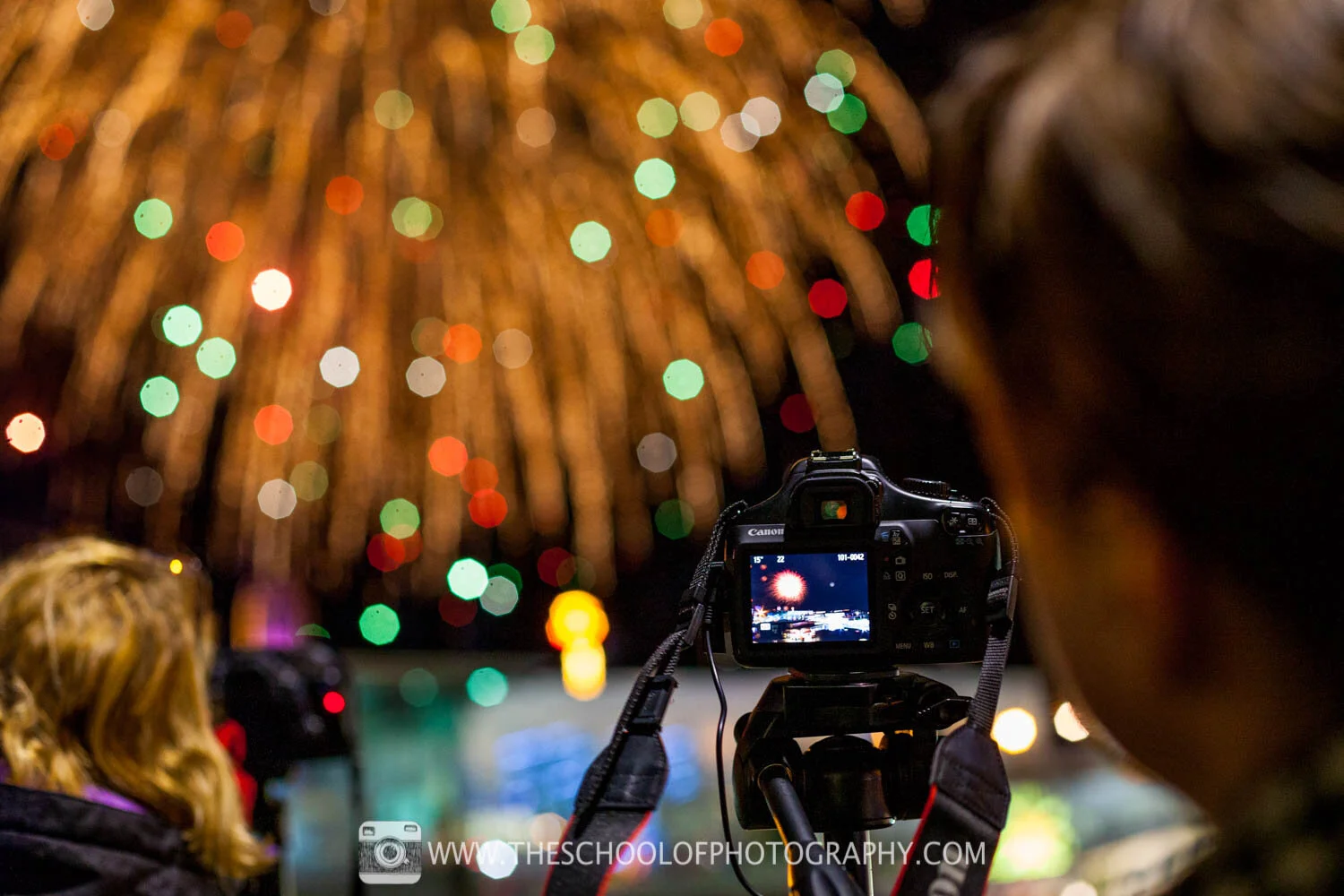
Using live view mode helps with composition and focus when photographing fireworks.
Get access to ALL our courses - 1000’s of videos, worksheets, critiques of students work, personalised support and much more with our monthly membership.
Like this? - Check out free tutorials below


Learn More About Photographing Fireworks
Get access to ALL our online photography courses, including:
Fireworks photography
Night photography
Long exposure techniques
Personalised feedback and critiques

Marc Newton